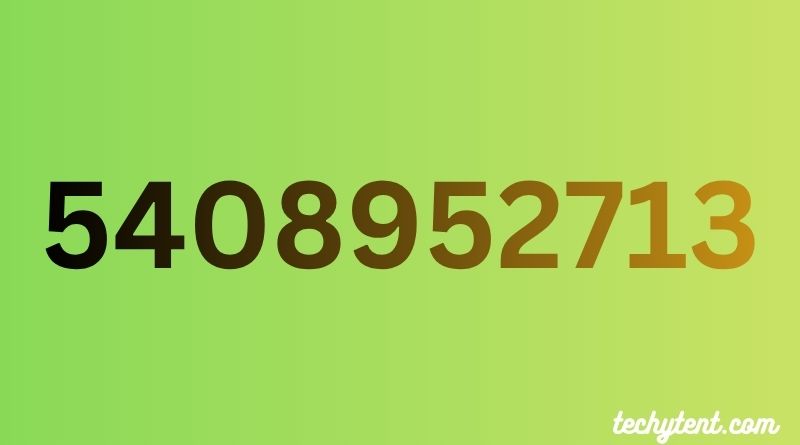
In a world increasingly driven by data, digits, and digital identifiers, certain numbers capture attention for reasons that are not always immediately obvious. The number 5408952713 is one such sequence that has surfaced in various contexts, prompting curiosity among those who encounter it. Whether it appears as a phone number, a reference code, a tracking identifier, or a digital footprint left across online platforms, understanding what lies behind a specific number like this one requires careful investigation, a working knowledge of how numerical identifiers function in modern systems, and an appreciation for the broader infrastructure that makes our connected world operate seamlessly.
Understanding Numerical Identifiers in the Digital Age
Every day, billions of numbers are generated, assigned, and circulated across telecommunications networks, databases, customer service systems, and online platforms. From social security numbers to product barcodes, from IP addresses to phone numbers, numerical identifiers serve as the backbone of modern organization. The sequence 5408952713 follows the format of a ten-digit number, which is most commonly associated with North American telephone numbers under the North American Numbering Plan (NANP). This plan governs the assignment of phone numbers across the United States, Canada, and several other territories, making ten-digit sequences one of the most frequently encountered forms of numerical identification in everyday life.
When people search for a specific number online, they are often motivated by a variety of concerns. They may have received an unexpected call, found the number listed on a document, or stumbled upon it in a directory. Understanding the structure behind such a number can provide meaningful context. In the case of 5408952713, the area code 540 points to a geographic region in the Commonwealth of Virginia, specifically covering areas such as Roanoke, Fredericksburg, and the Shenandoah Valley region. This regional anchoring is the first step in understanding what kind of entity or individual might be associated with a given number.
The Role of Area Codes and What They Reveal
Area codes are not arbitrary. They were designed as a systematic method to divide large geographical territories into manageable communication zones, allowing telephone exchanges to function efficiently without overlap or confusion. The 540 area code was created in 1995 when it was split off from the 703 area code, which had grown too large to sustain continued growth in phone number demand. Today, 540 covers a broad swath of western and central Virginia, encompassing both urban centers and rural communities that rely heavily on telecommunications infrastructure for business, healthcare, education, and personal communication.
When a number like 5408952713 appears in someone’s call log or inbox, the area code immediately provides a geographic clue. However, it is important to note that in the modern era of mobile telecommunications, area codes are no longer strictly tied to a person’s current location. With mobile number portability — a regulation that allows users to keep their phone numbers when switching carriers or moving to different states — a Virginia area code no longer guarantees that the caller is physically located in Virginia. This is a critical nuance that anyone researching a number should keep in mind, as it affects the conclusions one can draw from geographic data alone.
Why People Research Specific Phone Numbers
The motivations for researching a number such as 5408952713 are as varied as the people conducting the research. One of the most common reasons is concern about unsolicited calls. Robocalls, telemarketing calls, and phone scams have become an epidemic in recent years, with the Federal Trade Commission reporting hundreds of millions of unwanted calls made to Americans every year. When someone receives a call from an unfamiliar number, their instinct is often to investigate before returning the call or engaging further. Reverse phone lookup services, community reporting platforms, and public directories have all emerged to help individuals make informed decisions about unknown callers.
Another reason people search for specific numbers is professional due diligence. Businesses frequently verify contact information before entering into agreements with new clients or vendors. In legal proceedings, phone records and the identification of specific numbers can serve as evidence. Journalists and investigators use phone number research as part of broader inquiries. In each of these cases, the goal is the same: to attach reliable, verifiable information to a sequence of digits so that informed decisions can be made based on something more substantial than guesswork.
Spam, Scams, and the Importance of Number Verification
One of the most pressing issues surrounding unfamiliar phone numbers today is the prevalence of fraud. Scammers have become increasingly sophisticated, using techniques like number spoofing to make calls appear as though they originate from legitimate local numbers, government agencies, or well-known businesses. A number displayed on your caller ID may not actually belong to the entity placing the call, which complicates efforts to trace or report fraudulent activity. This is why number verification must be approached with caution and cross-referenced across multiple sources whenever possible.
If 5408952713 has been flagged by community members on call-reporting websites, that information can be genuinely useful. Platforms such as WhoCalledMe, CallerSmart, and similar services allow users to leave comments about their experiences with specific numbers, creating a crowdsourced database of information that helps others avoid potential scams. However, it is equally important to recognize that not every unfamiliar number is malicious. Many calls from unknown numbers are entirely legitimate — from healthcare providers following up on appointments, to local businesses confirming orders, to school systems sending automated notifications.
Protecting Yourself From Unwanted Calls
Understanding a number like 5408952713 is part of a broader strategy for protecting yourself in an era of aggressive telecommunications abuse. There are several practical steps that individuals can take to reduce their exposure to unwanted calls and to manage the ones they do receive more effectively. Registering your number with the National Do Not Call Registry is a foundational step, though it primarily addresses legitimate telemarketers and does not deter criminal operators. Using call-blocking features available through your mobile carrier or third-party apps provides an additional layer of defense.
Staying informed about current scam tactics is equally important. Scammers frequently adapt their methods in response to public awareness campaigns and regulatory changes. One common tactic is the “one-ring” scam, where a call is placed and disconnected after a single ring, hoping that curiosity will prompt the recipient to call back — often to a premium-rate number that charges substantial fees. Another tactic involves impersonating government officials, such as IRS agents or Social Security Administration employees, to intimidate recipients into providing personal information or making payments. Being aware of these schemes empowers individuals to respond appropriately rather than reactively.
The Broader Significance of Number Research in a Connected World
The act of researching a number like 5408952713 reflects something fundamentally important about how we navigate trust and verification in a digitally connected society. We are constantly bombarded with information, solicitations, and communications from entities we may not immediately recognize. The tools and habits we develop to assess the legitimacy of these interactions have real consequences for our privacy, security, and financial wellbeing.
Public literacy around telecommunications identifiers, fraud prevention, and digital verification is not just a convenience — it is increasingly a necessity. Schools, community organizations, and government agencies all have a role to play in educating the public about these issues. At the same time, the private sector, including phone carriers and technology companies, bears a responsibility to invest in solutions that reduce the burden placed on individual consumers to defend themselves against bad actors who exploit the very infrastructure designed to keep us connected.
Final Thoughts on Understanding Unknown Numbers
Whether 5408952713 is a number you have encountered on your phone, in a document, or through an online search, the process of researching it illustrates how much information can be drawn from what appears, at first glance, to be a simple string of digits. Area codes provide geographic context, carrier databases offer ownership information, and community reporting platforms contribute real-world experience that no single official database can replicate. Together, these resources form a reasonably comprehensive picture that can guide your next steps.
The key takeaway is that no number should be dismissed or acted upon without context. Taking a moment to investigate before responding is always the wiser course of action. In doing so, you protect not only yourself but also contribute to a culture of informed, cautious digital citizenship that benefits everyone who participates in our shared telecommunications ecosystem.